NA 2026.014
Last revised
Nihontō · Yari · Koshirae
Yari Study II
槍 · 柄・鞘付
Period unrecorded · not established
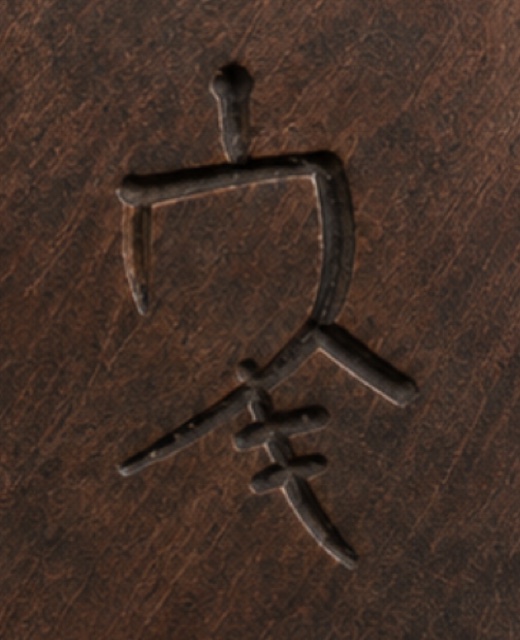
A 14.9 cm su-yari head with its long tang, complete with lacquered shaft and a fitted head cover. The source describes it as unsigned, but a short column of chiselled characters is visible on the tang.
AttributionInscription present · unread · 銘あり(判読不能)A vertical column of chiselled characters is visible on the tang; it is not legible at gallery resolution and no maker is proposed
- Nagasa
- 14.9 cm
- Mei
- Characters present · unread
- Condition
- Rusted · unpapered
Object record
Overview
Object record
- Item
- Yari (槍) with its e (柄) and a fitted head cover
- Mei
- Chiselled characters present on the tang · not legible
銘あり(判読不能) - Nagasa
- 14.9 cm
- Width
- Motohaba 1.9 cm
- Kasane
- Motogasane 0.9 cm
- Form
- Su-yari · straight head, stout lenticular section, no groove
- Nakago
- Full length, longer than the head; one mekugi-ana
- Period
- Unrecorded · no appraisal paper supplied
Condition record
- Photographs
- Twenty-one archival photographs · no video
- Documents
- No registration card, NBTHK/NTHK paper, or other certificate shown
- Completeness
- Head, tang, shaft, collar and head cover all present; head draws freely
Photographic record
Plates · 21
Available views arranged as a comparative object study; descriptions distinguish observation from documentary attribution.
Click underlined specialist terms for concise notes and construction diagrams.
IV
Mounting & Cover
柄・鞘
8 plates
Plate IV.1 · 柄・鞘
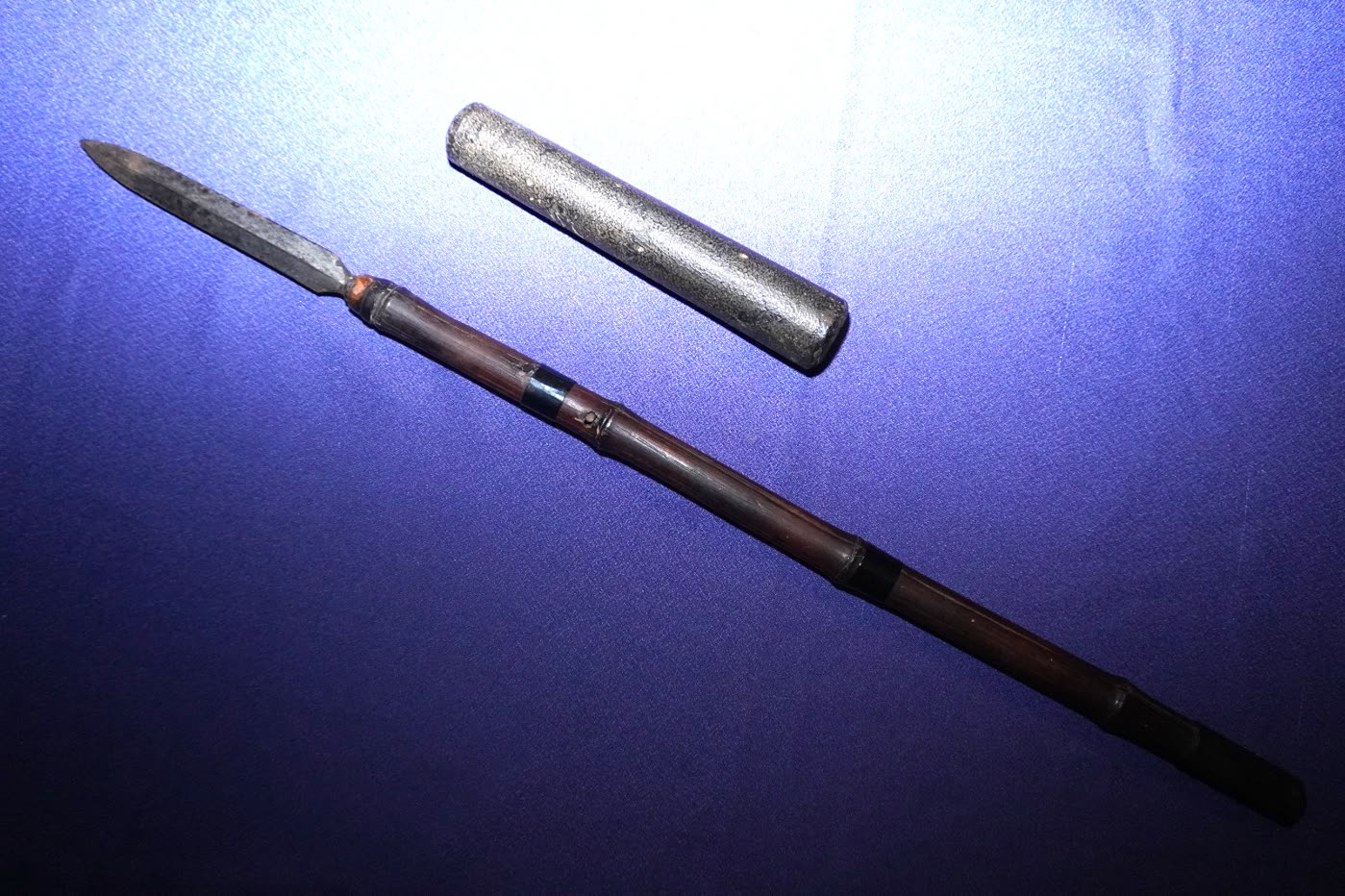
All components
Everything the lot contains: the head seated on its lacquered shaft, and the separate cover that sheathes the head when the weapon is stored or carried.
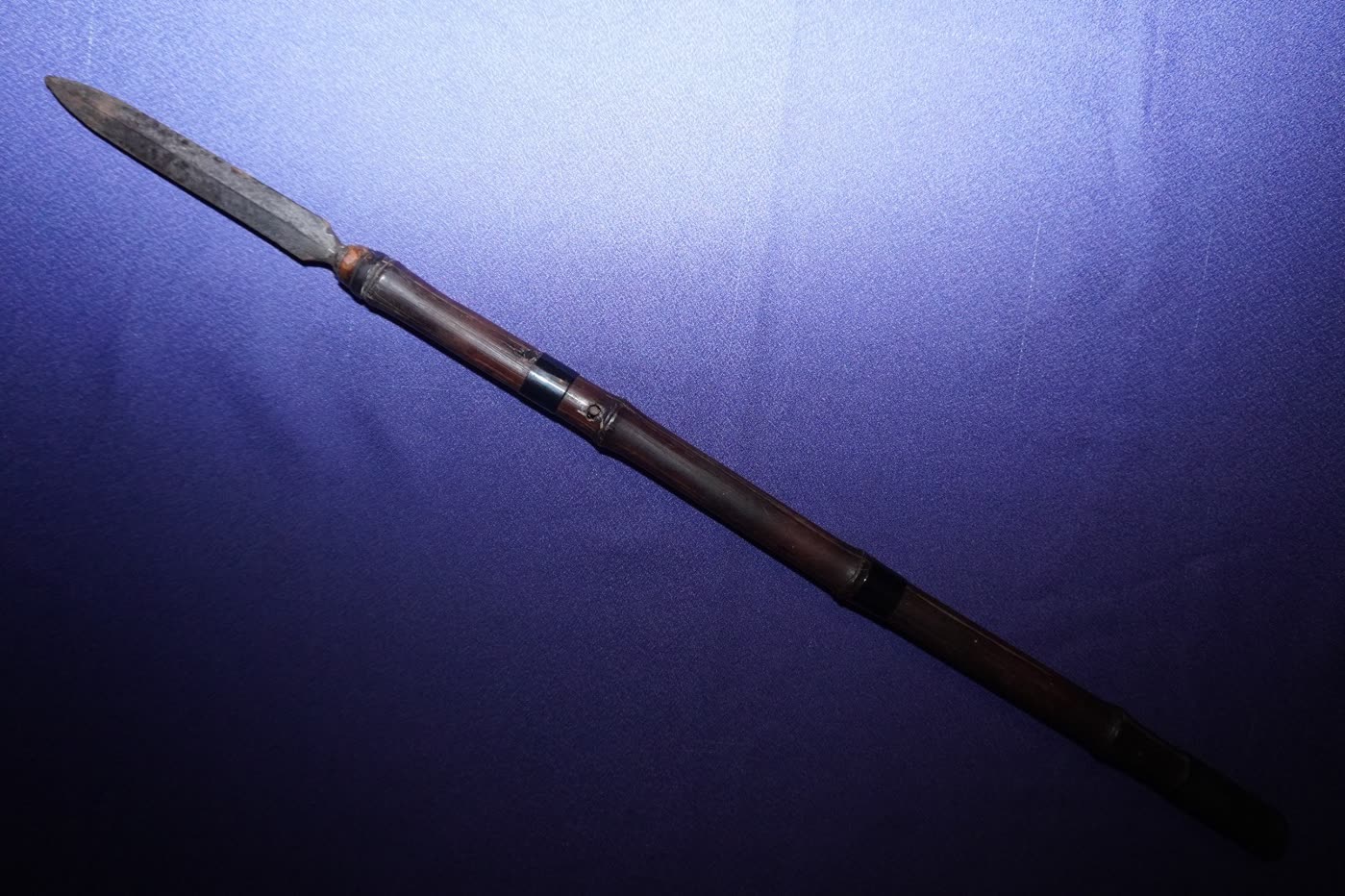
Plate IV.2 · 柄・鞘
Assembled
The yari assembled. The shaft is dark red-brown lacquered wood with two black bands and a visible retaining pin below the head; its surviving length is a fraction of an original polearm's.
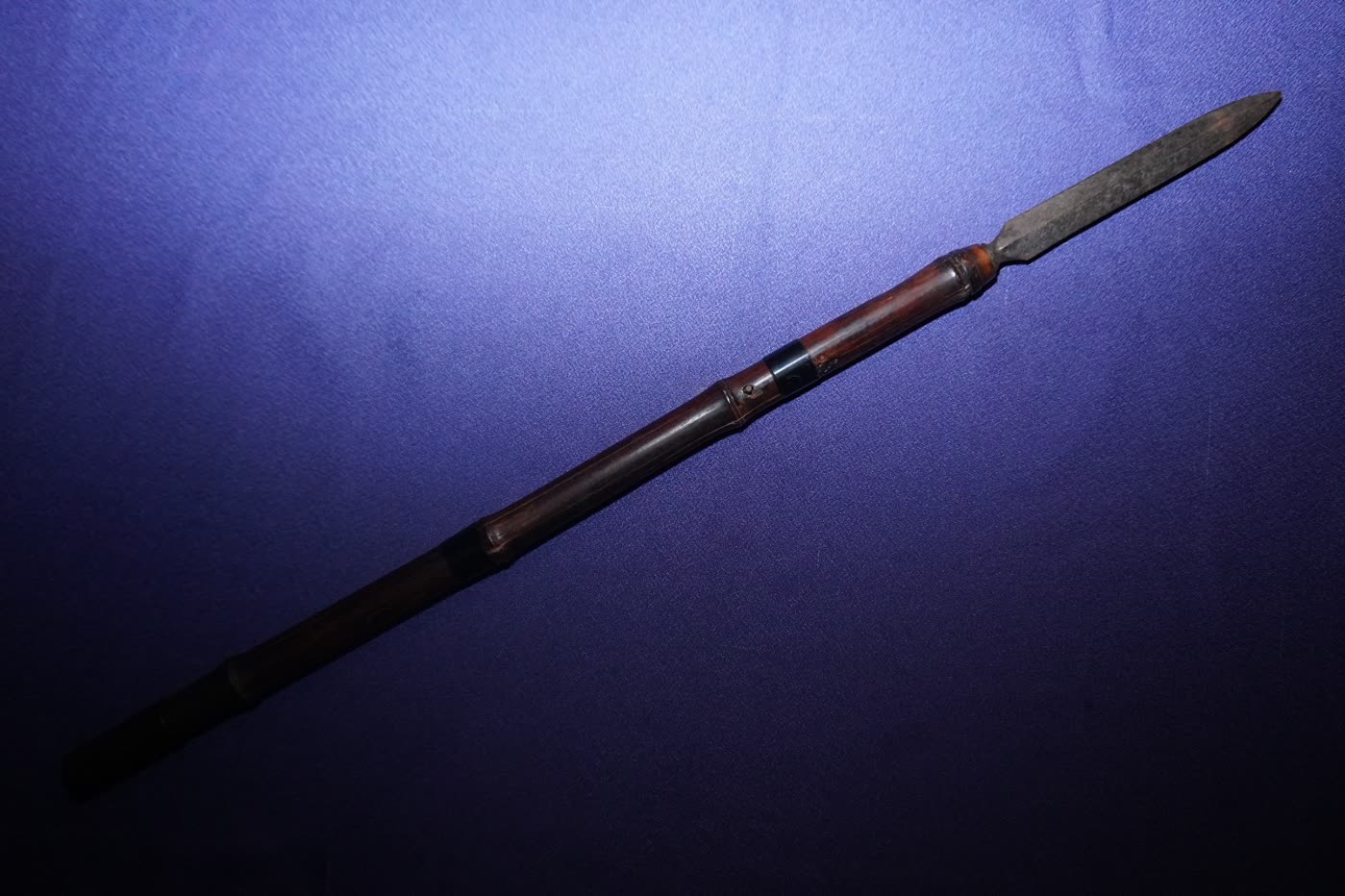
Plate IV.3 · 柄・鞘
Assembled · second view
The same assembly under a darker exposure, which brings out the depth of the lacquer and the banded joints along the shaft.
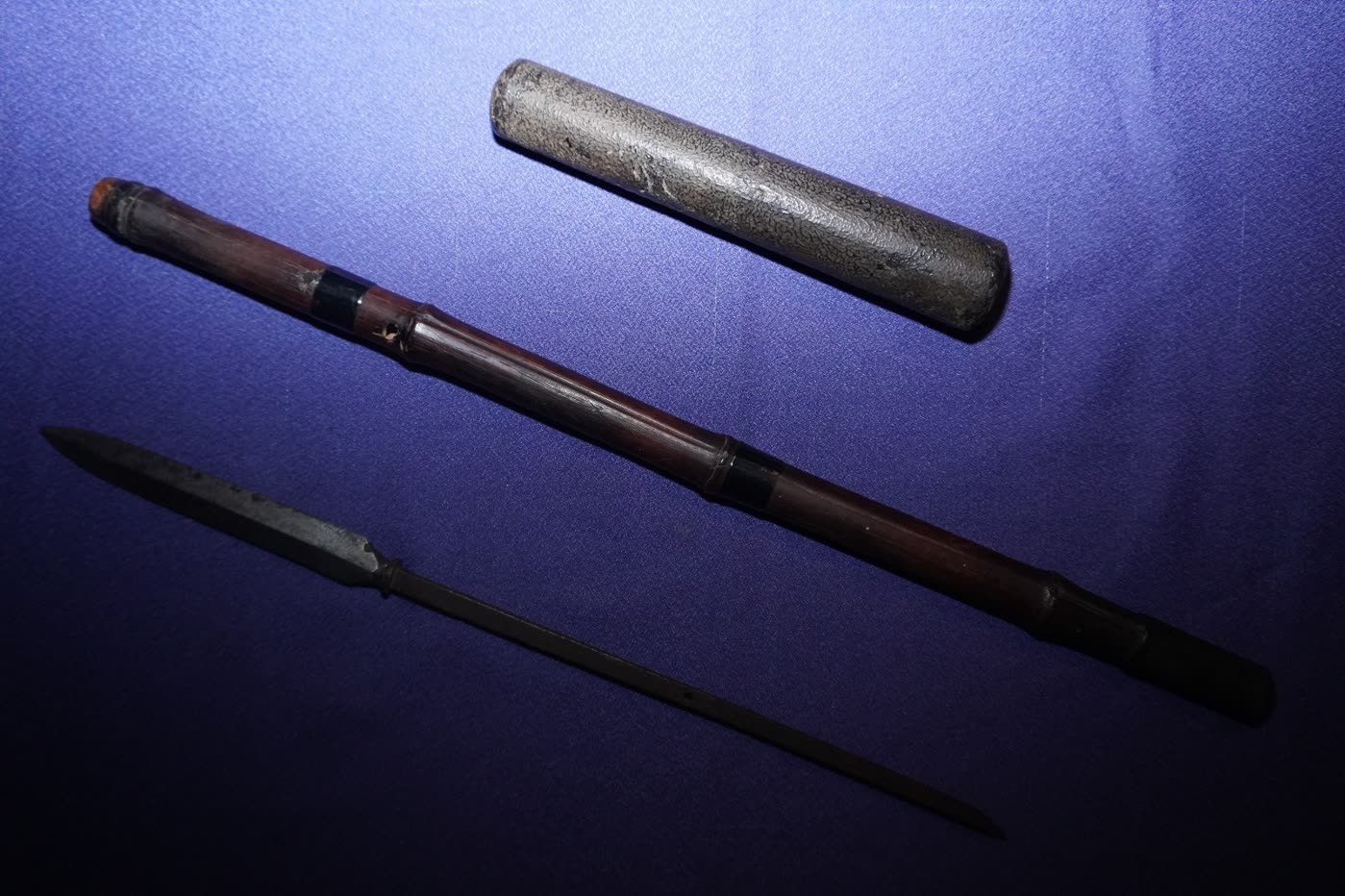
Plate IV.4 · 柄・鞘
Components apart
The head withdrawn and laid beside the shaft. This is the plate that matters for study: unlike a seized mounting, this head comes free, so the whole tang is available for examination.
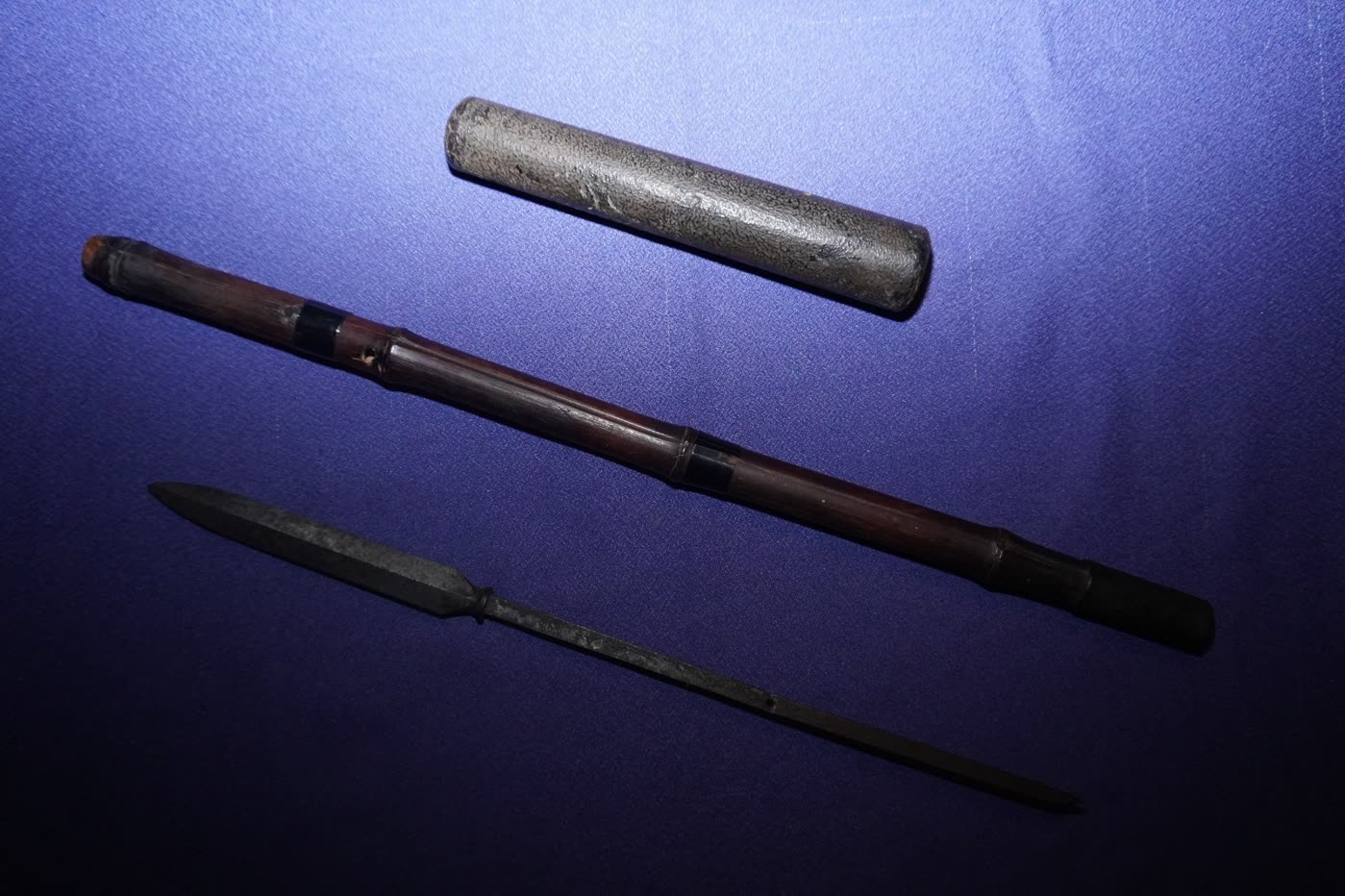
Plate IV.5 · 柄・鞘
Components · second framing
The same three parts framed more closely, giving the relative lengths of head, tang and shaft in one view.
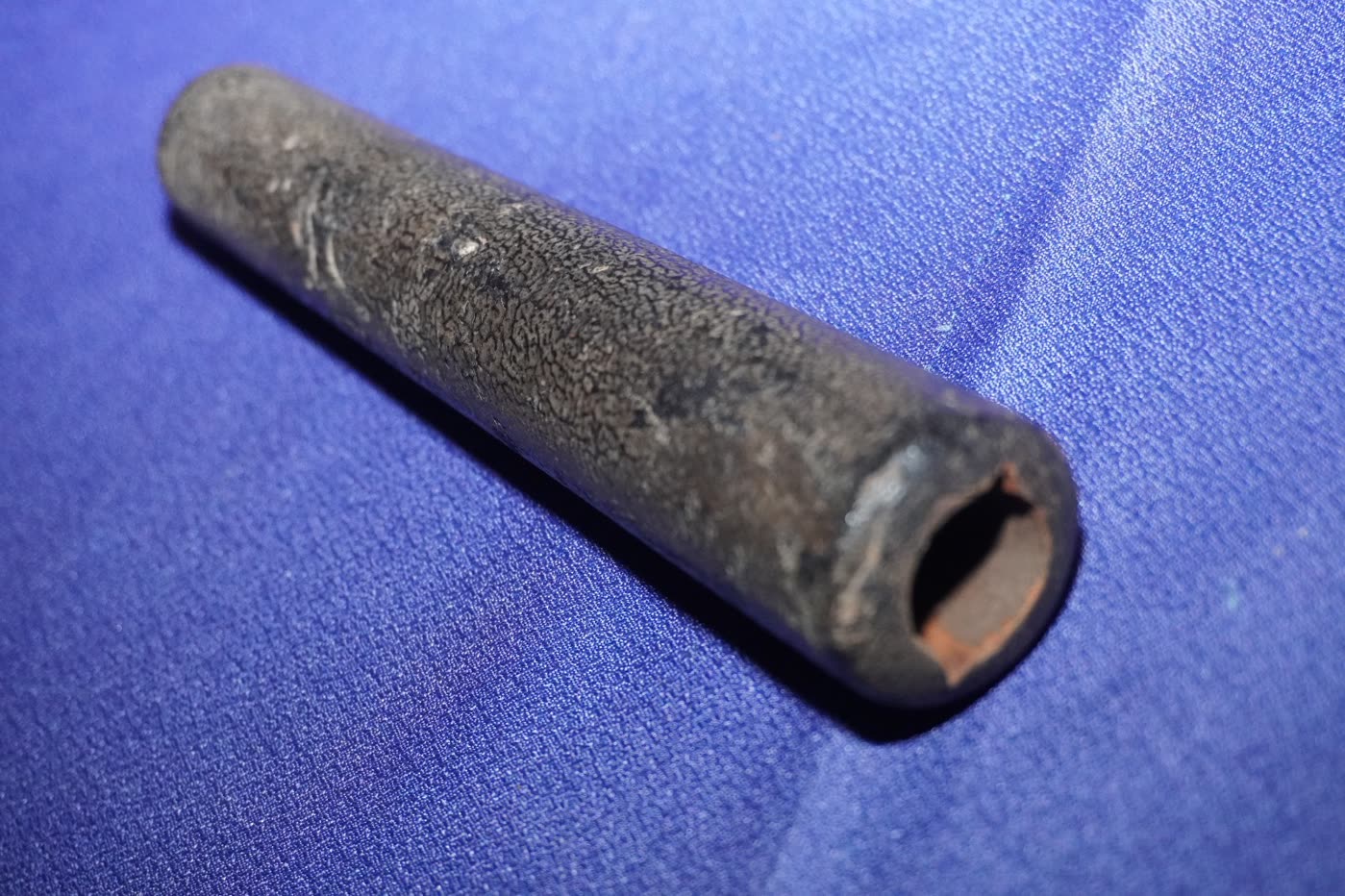
Plate IV.6 · 柄・鞘
Head cover
The cover for the head: a tube finished in a coarse granular lacquer, worn through to a lighter material around the mouth. Its bore is shaped to the head rather than round.
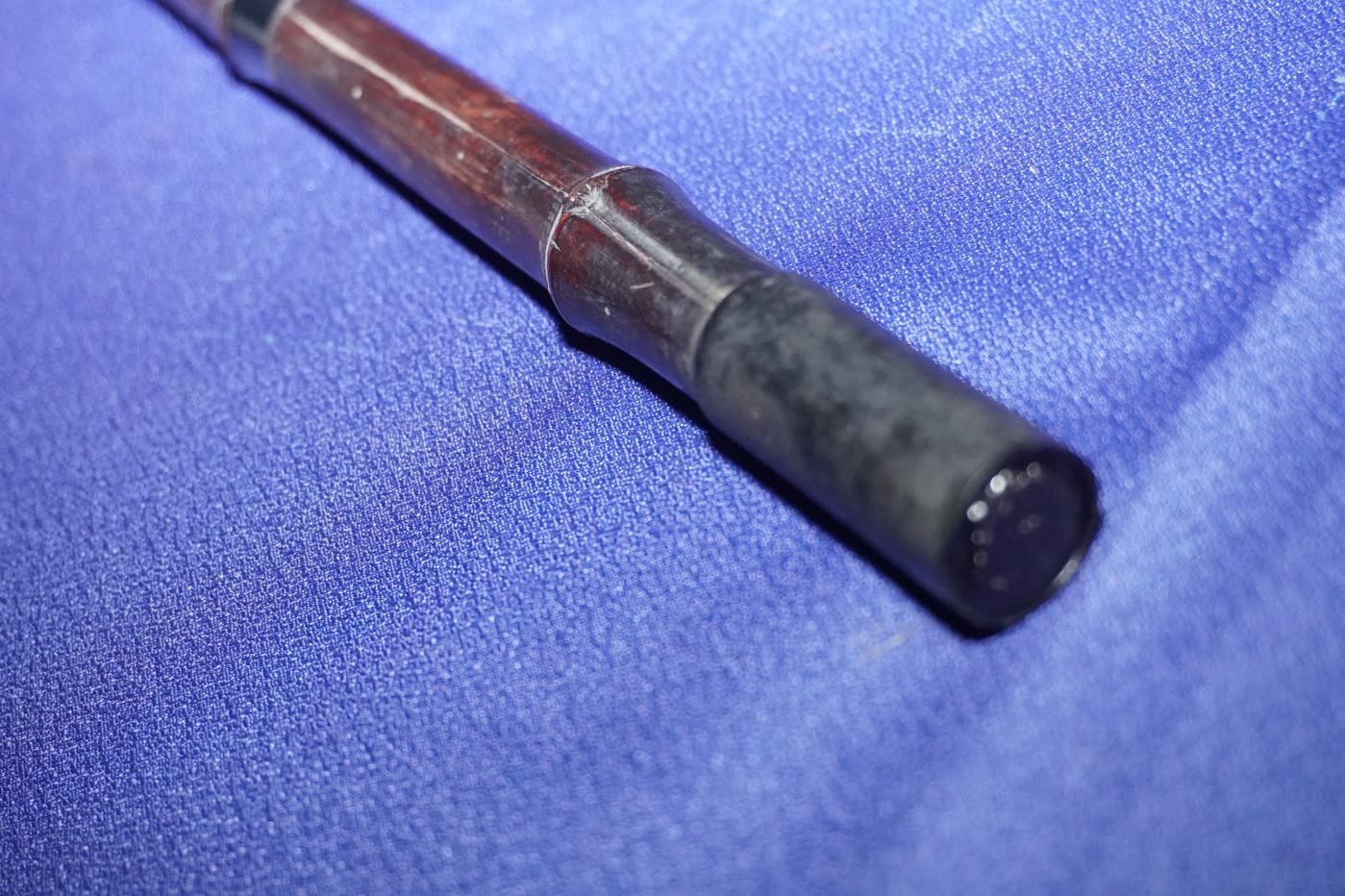
Plate IV.7 · 柄・鞘
Shaft · butt end
The butt of the shaft, closed with a dark fitting whose end face carries a scatter of small pale points. The lacquer runs up to it cleanly.
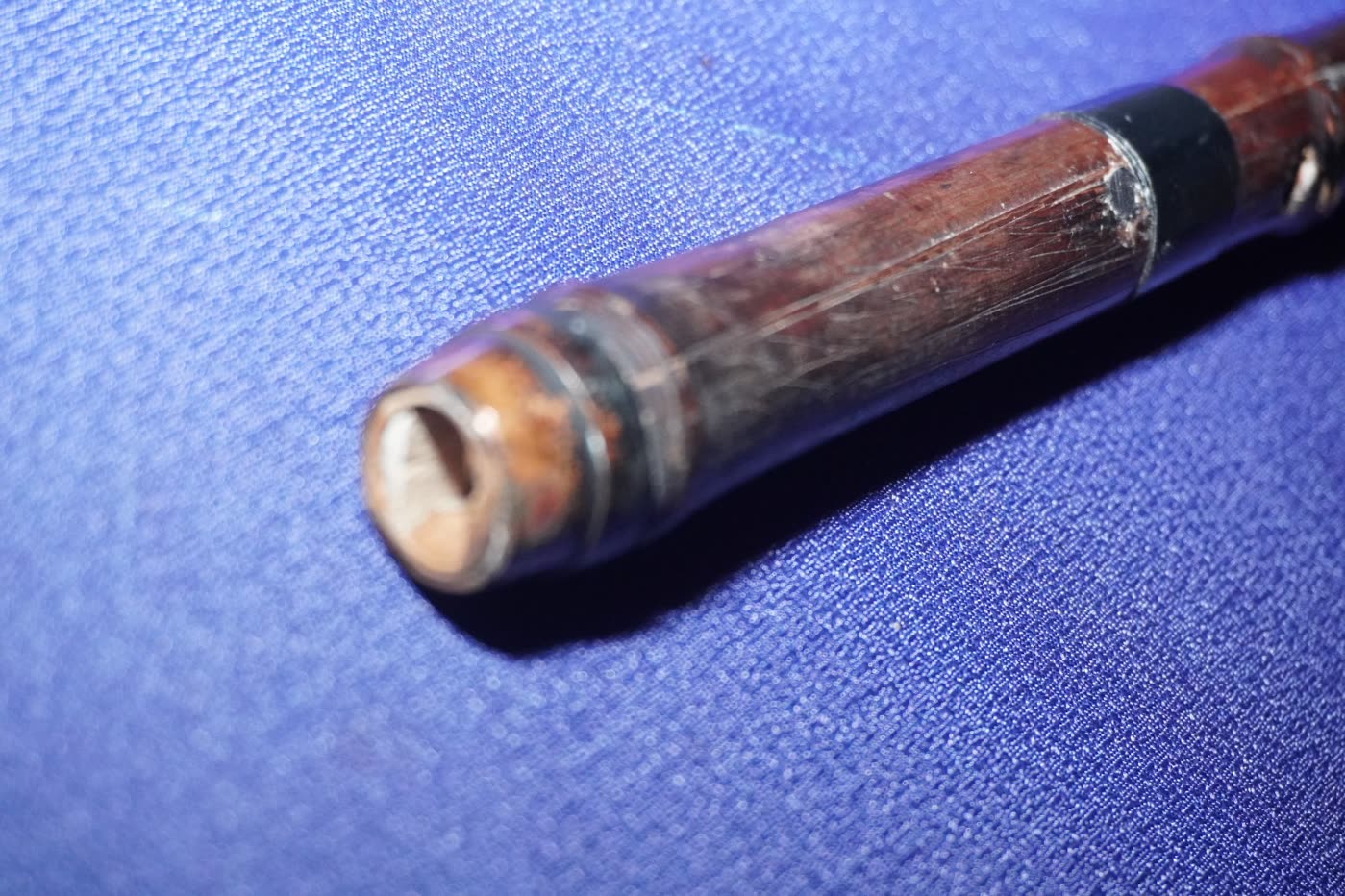
Plate IV.8 · 柄・鞘
Shaft · socket mouth
The socket at the head end, ringed with a metal collar. The mortise for the tang is visible inside, worn but clean, and fine age cracks run down the lacquer from the mouth.
II
Head & Nakago
穂・茎
13 plates
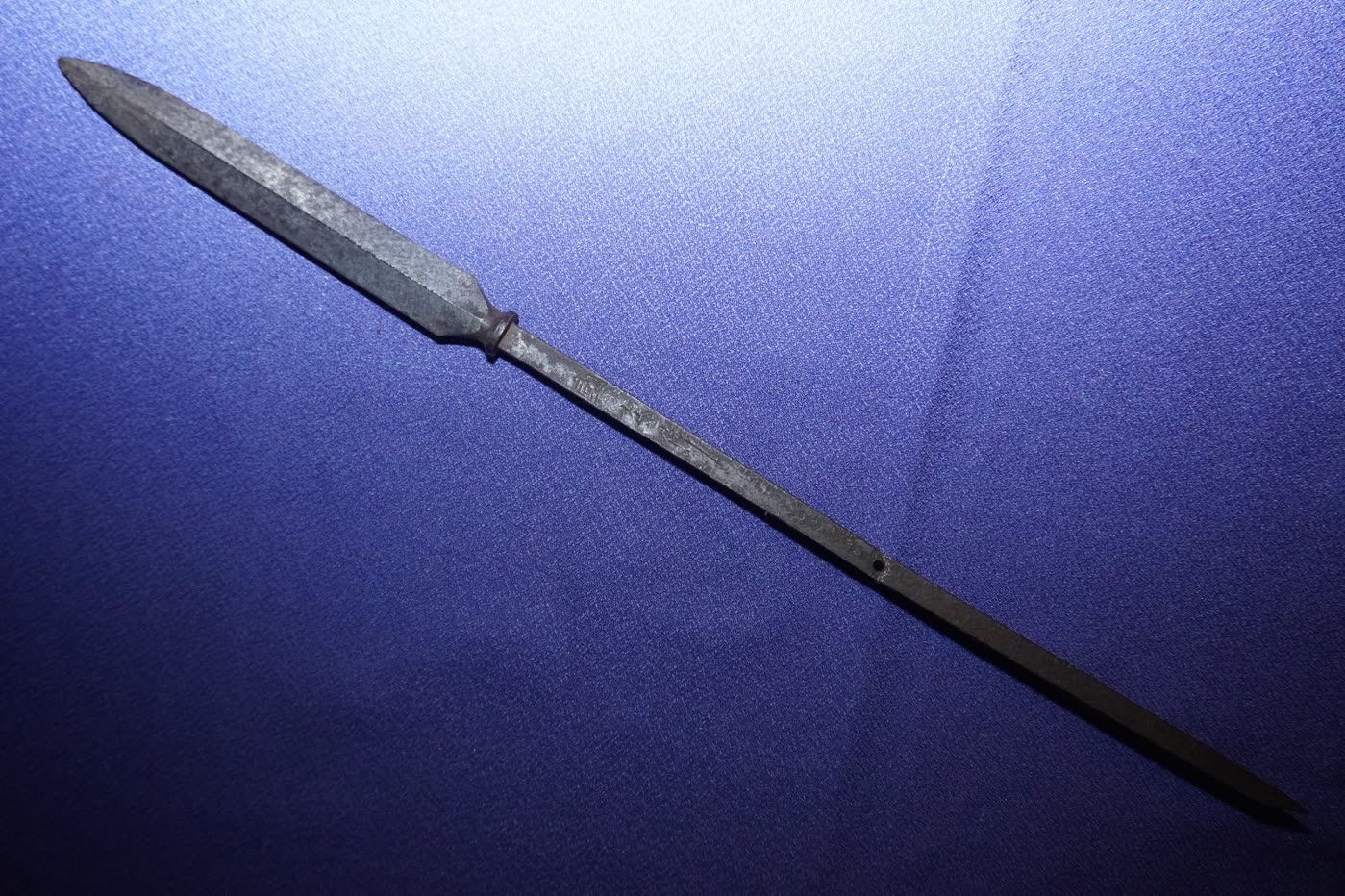
Plate II.1 · 穂・茎
Head & tang · first face
The head out of the shaft on its first face. The tang runs well over twice the length of the 14.9 cm head, tapering to a blunt point, with one punched roughly midway.
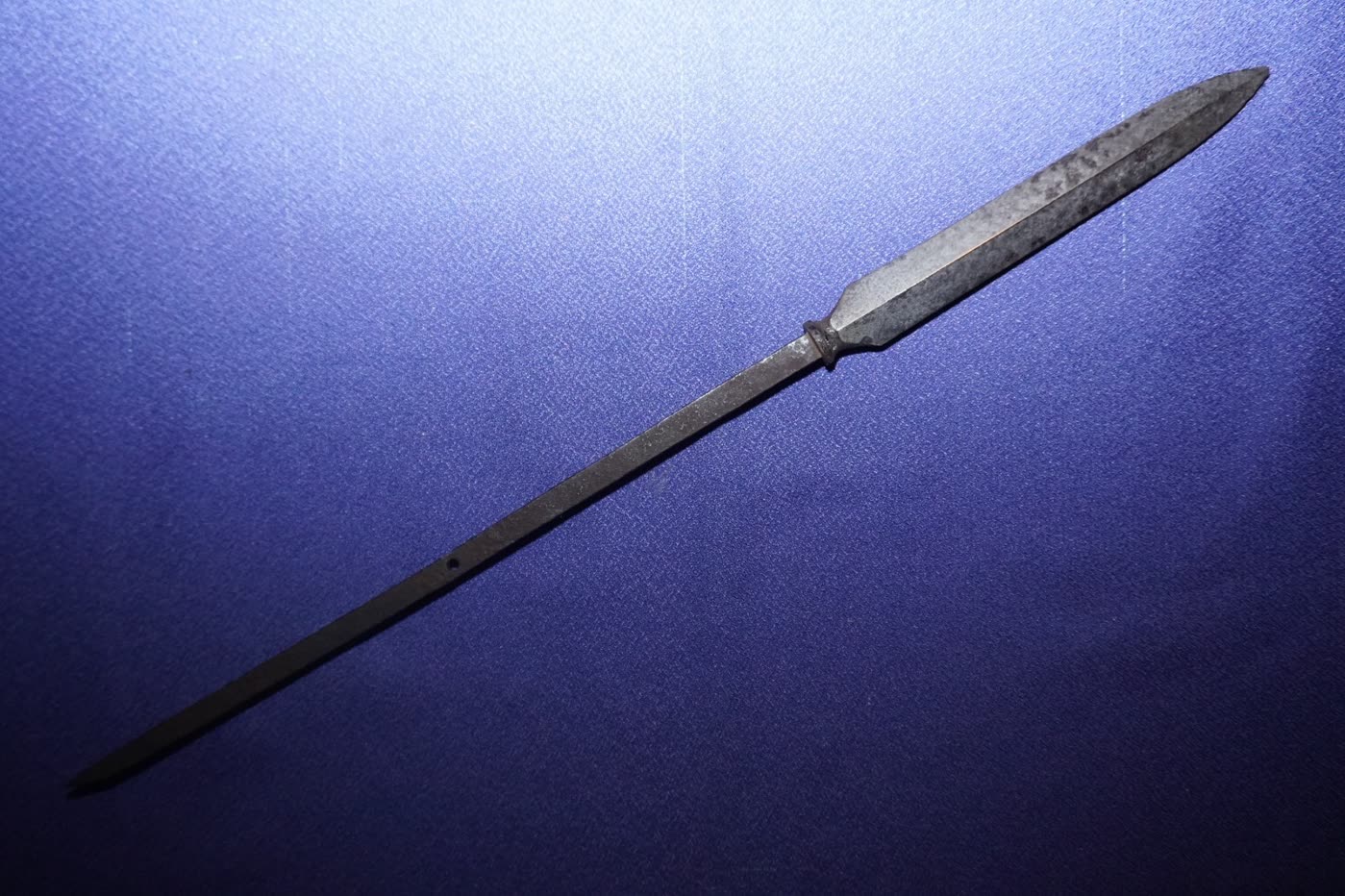
Plate II.2 · 穂・茎
Head & tang · second face
The reverse. The collar at the base of the head is a separate fitting, swollen and irregular where it has corroded onto the shoulder.
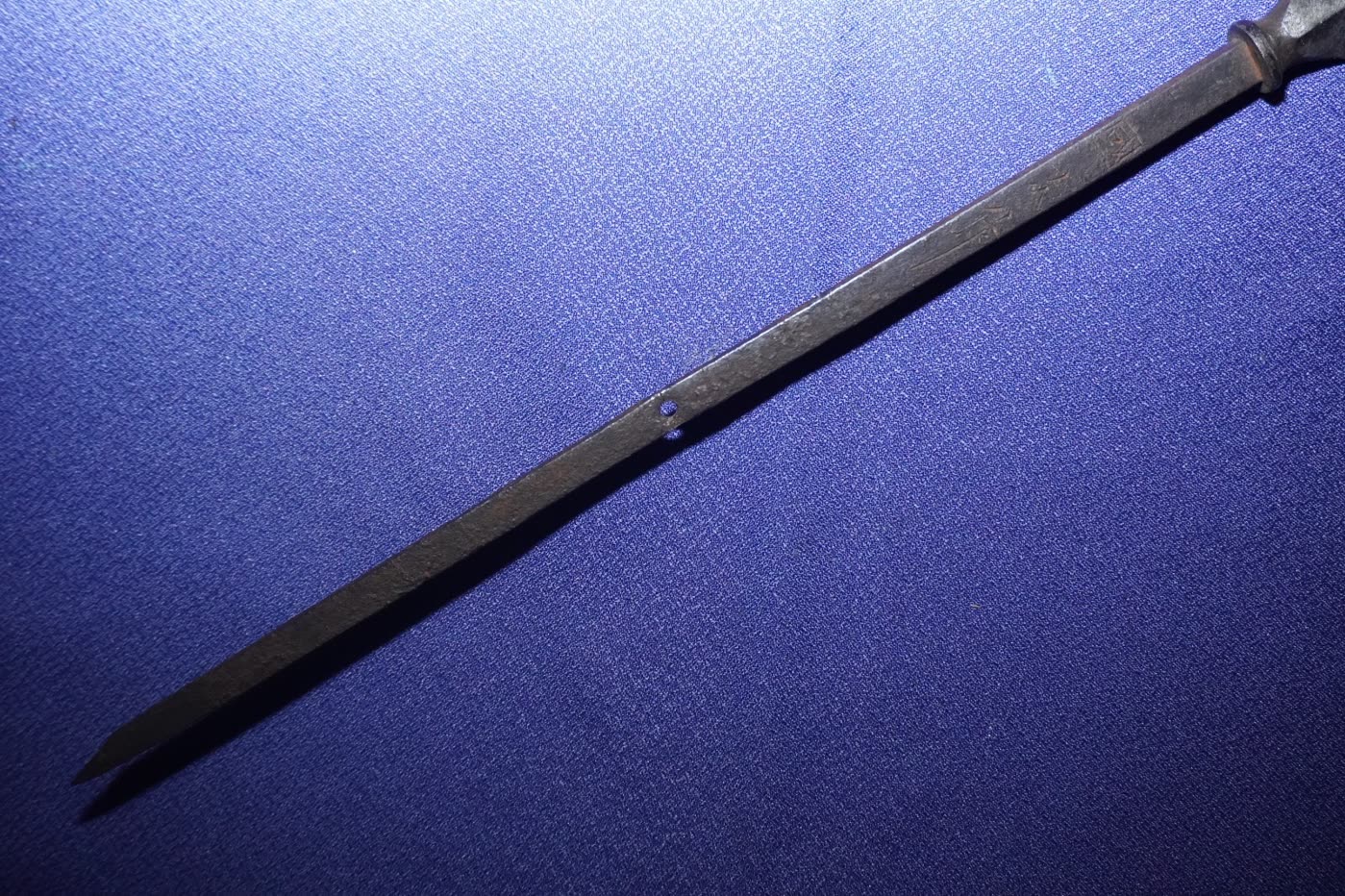
Plate II.3 · 穂・茎
· chiselled characters
The upper tang, just below the collar. A vertical column of at least three chiselled characters runs down the face, the uppermost enclosed within a squared outline. They are worn, coarse, and not legible at this resolution — but they are cut, not corroded, and the source description records this blade as unsigned.
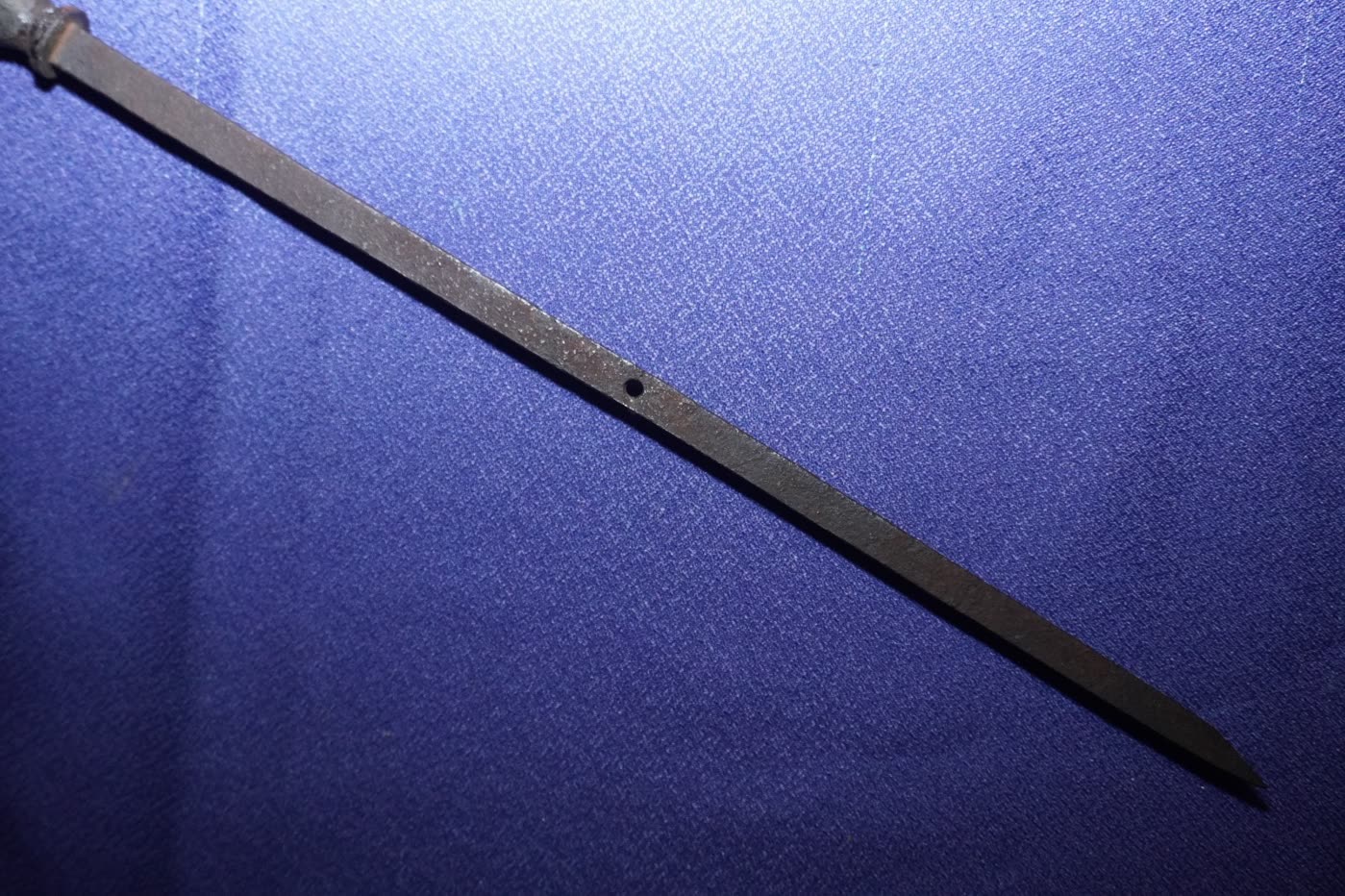
Plate II.4 · 穂・茎
·
The lower tang and its single , cleanly punched with no elongation. The surface here is smooth dark brown with no further marks.
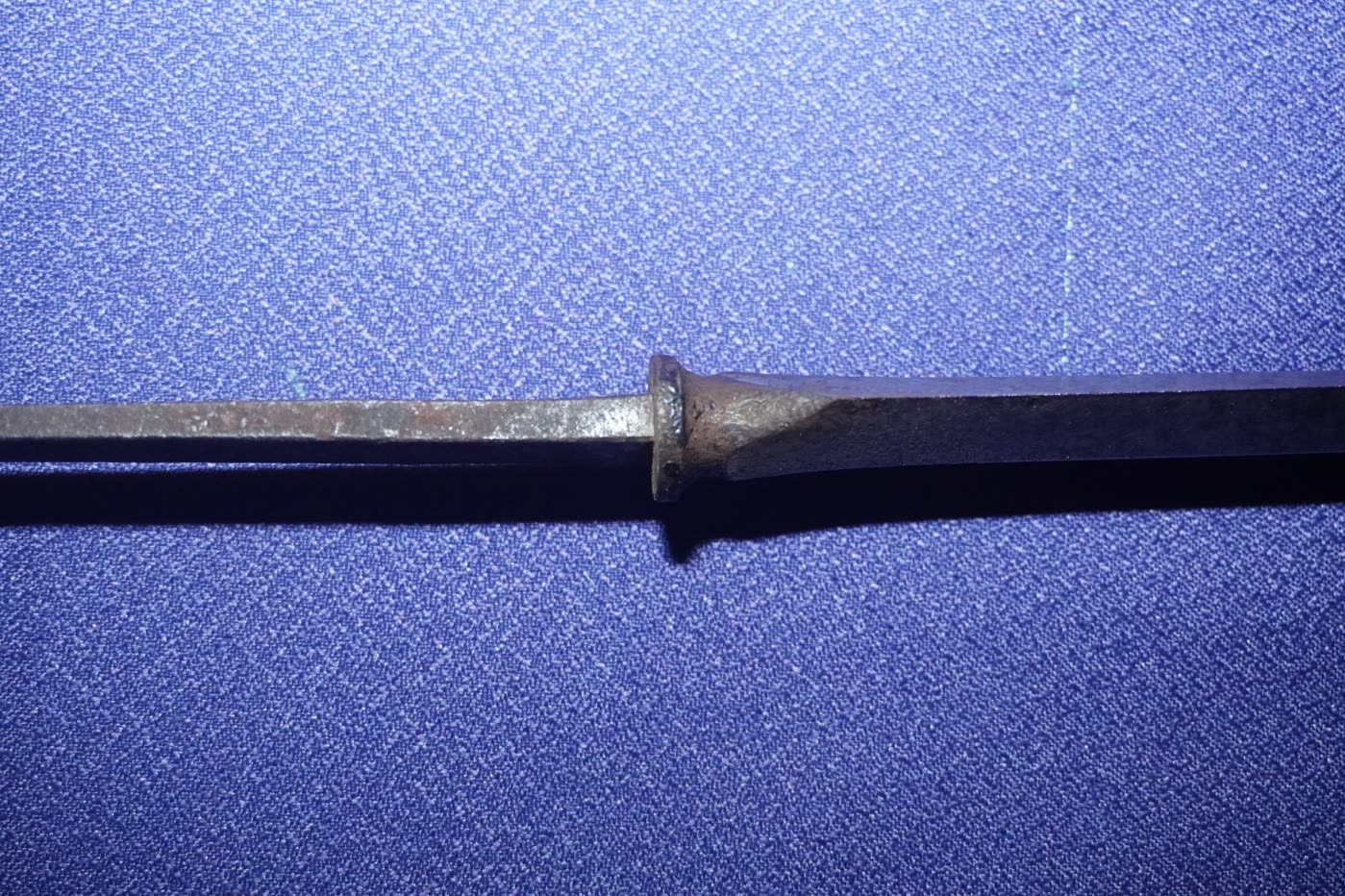
Plate II.5 · 穂・茎
Collar & junction
The collar at close range, seated where the head's shoulder meets the tang. Its edge is uneven and rust has bound it to the steel on one side.
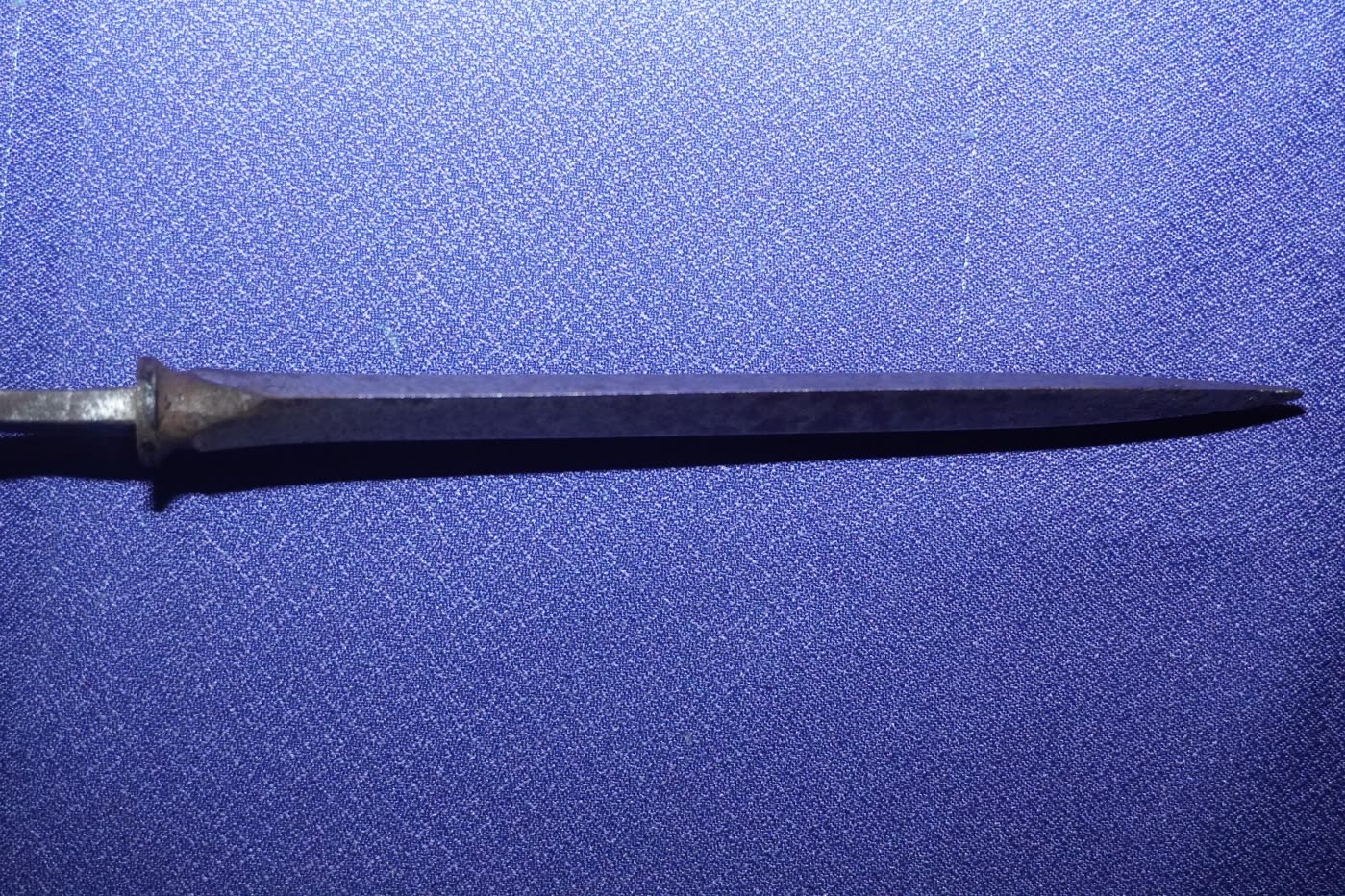
Plate II.6 · 穂・茎
Head · full profile
The head from collar to point in profile: a straight su-yari of even taper, its widest point close to the collar and the section falling away steadily to the tip.
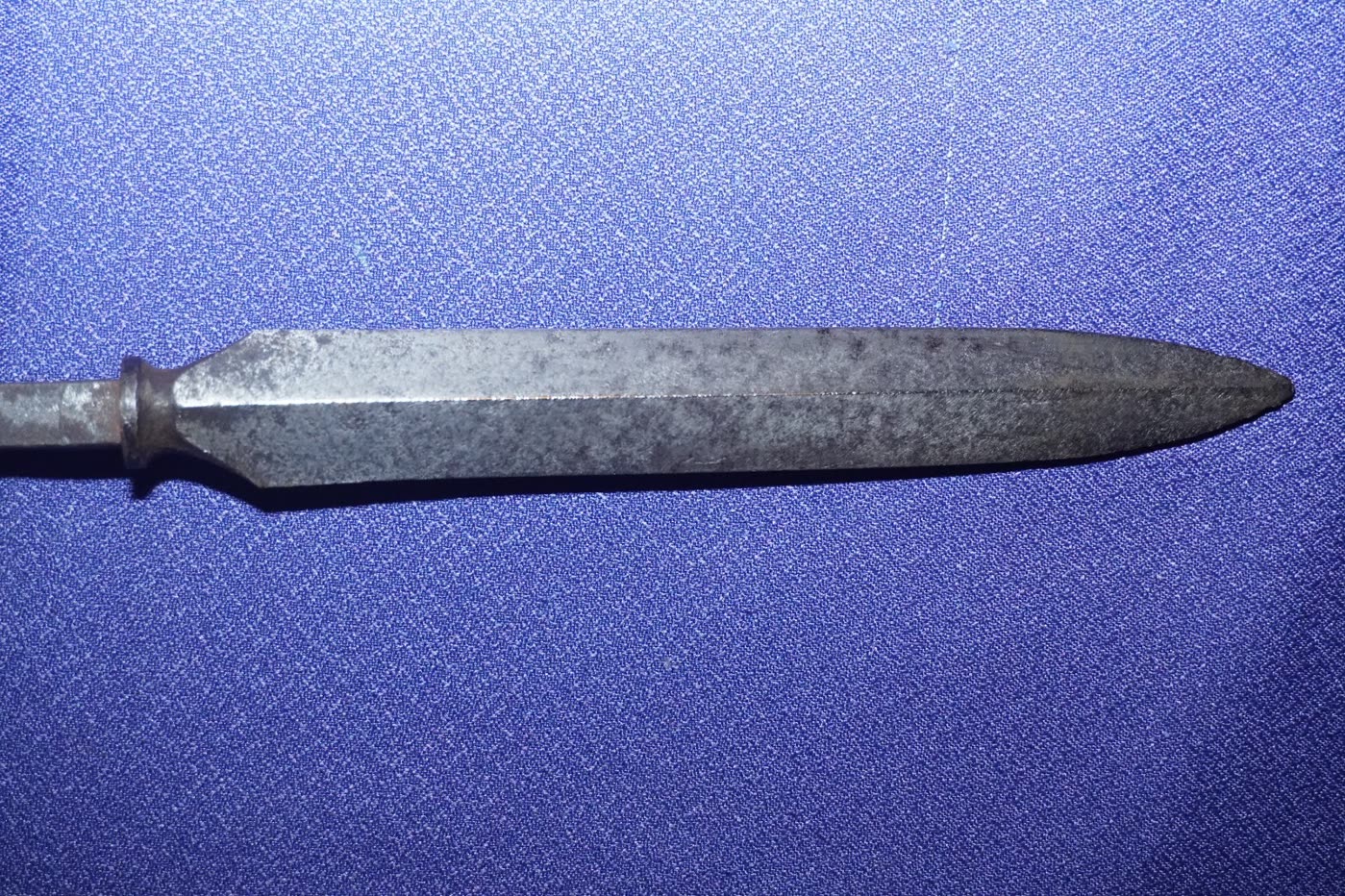
Plate II.7 · 穂・茎
Head · broadside
The head broadside. The surface is mottled grey and dark brown with fine even pitting; the central ridge runs unbroken to the point on both faces.
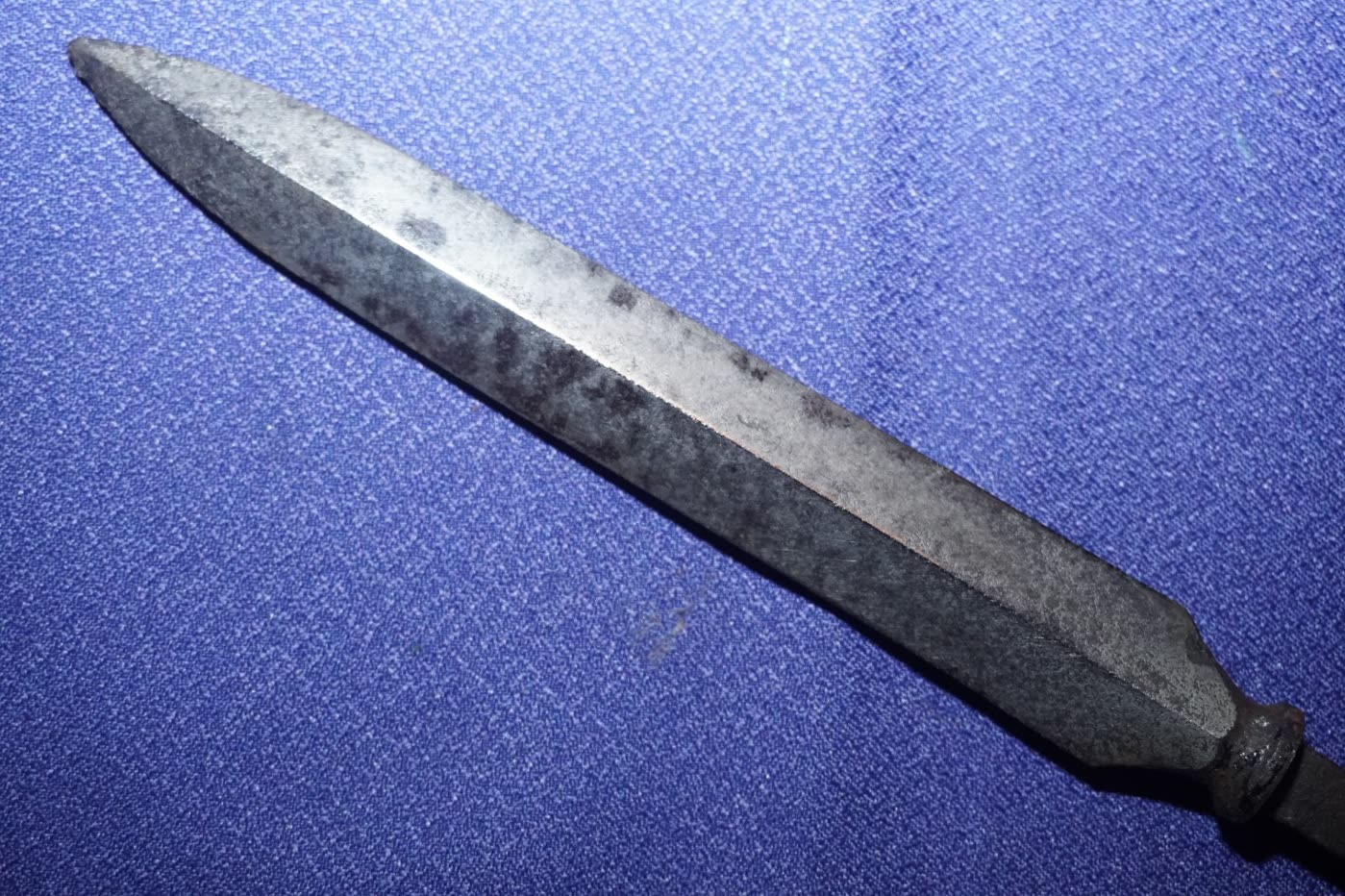
Plate II.8 · 穂・茎
Blade surface · first face
Close on the first face. The pitting is fine and evenly distributed, with paler patches where the surface has been rubbed back; the edge line is unbroken along its length.
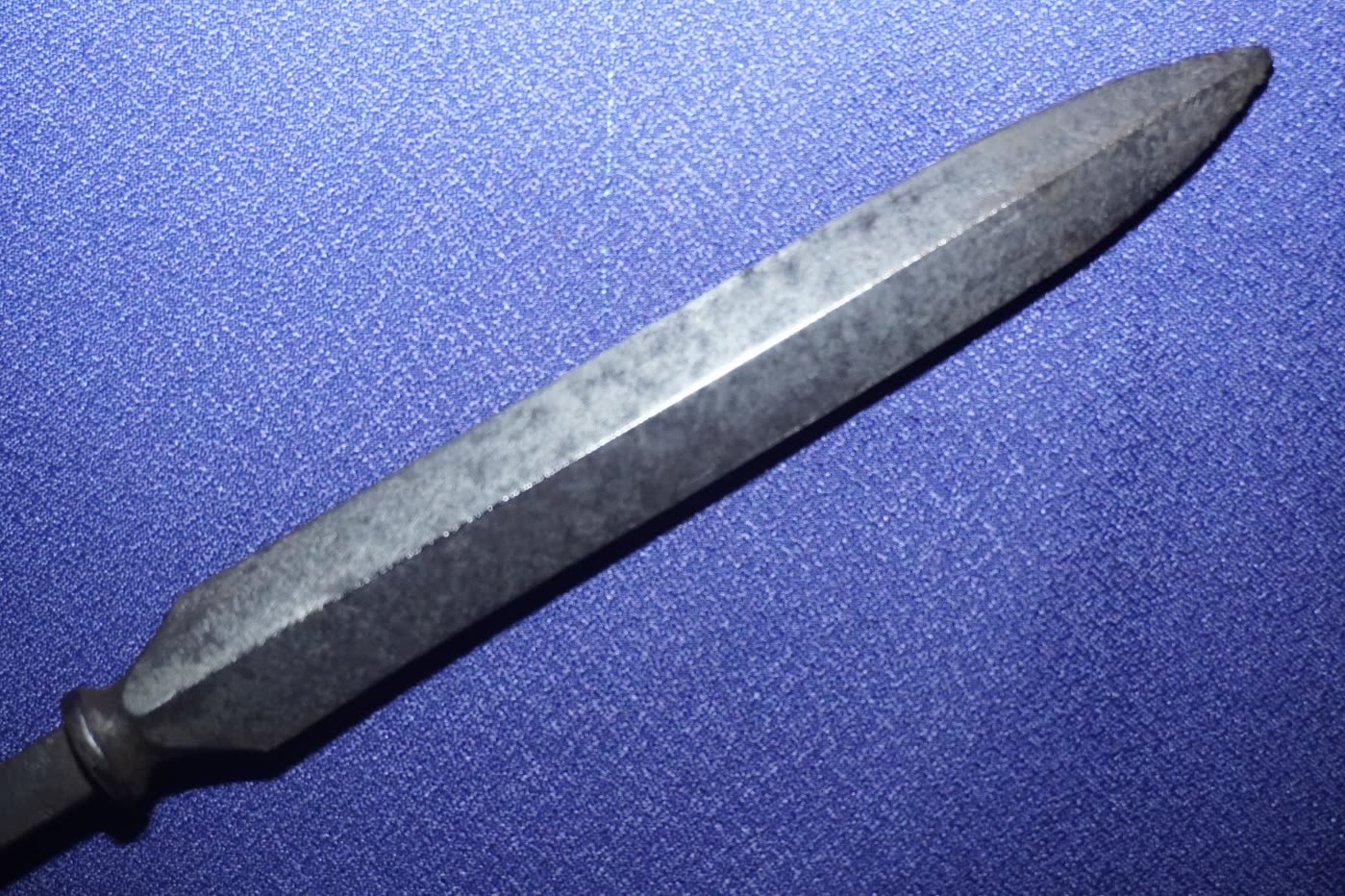
Plate II.9 · 穂・茎
Blade surface · second face
Close on the second face, which is marginally cleaner. A soft lighter band follows the edge on this side; whether that reflects a under the corrosion is not settled from photographs.
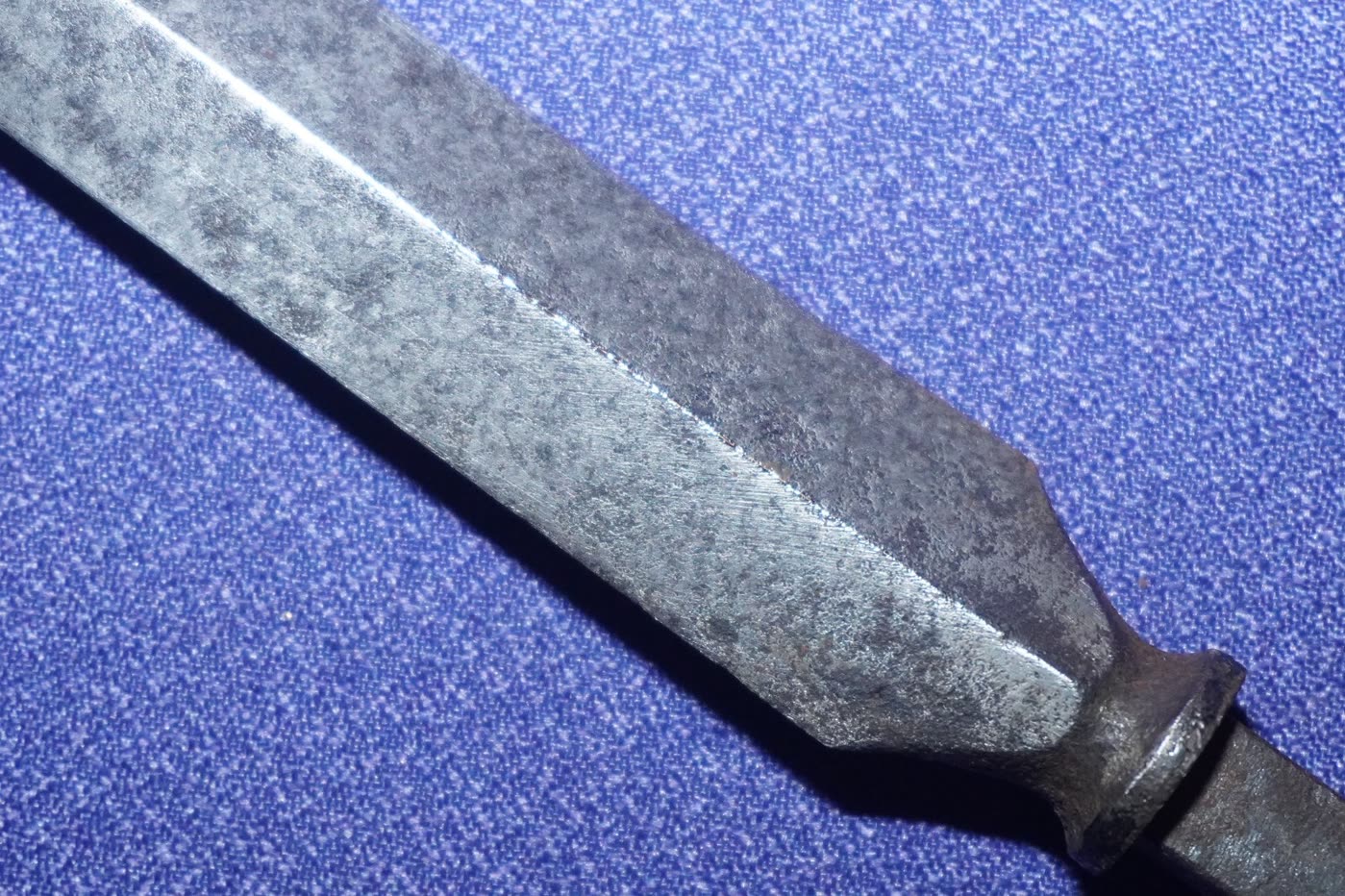
Plate II.10 · 穂・茎
Ridge & shoulder
The ridge and the shoulder above the collar. The facets meet crisply, which suggests the geometry has not been ground away in any later cleaning.
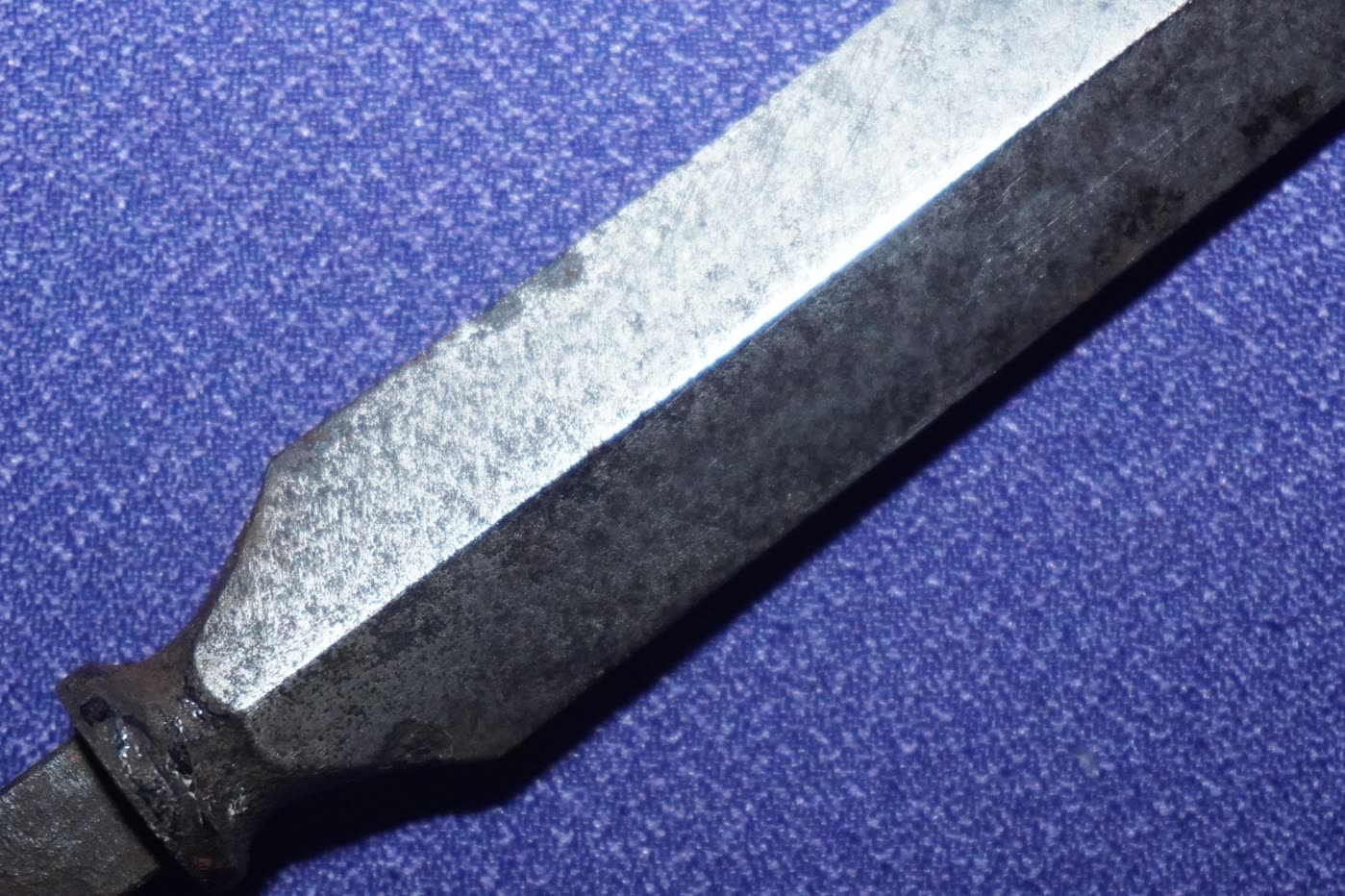
Plate II.11 · 穂・茎
Base of the blade
The base of the blade above the collar, where the width is greatest and the section thickest. Grinding marks from an old sharpening run at a shallow angle across the flat.
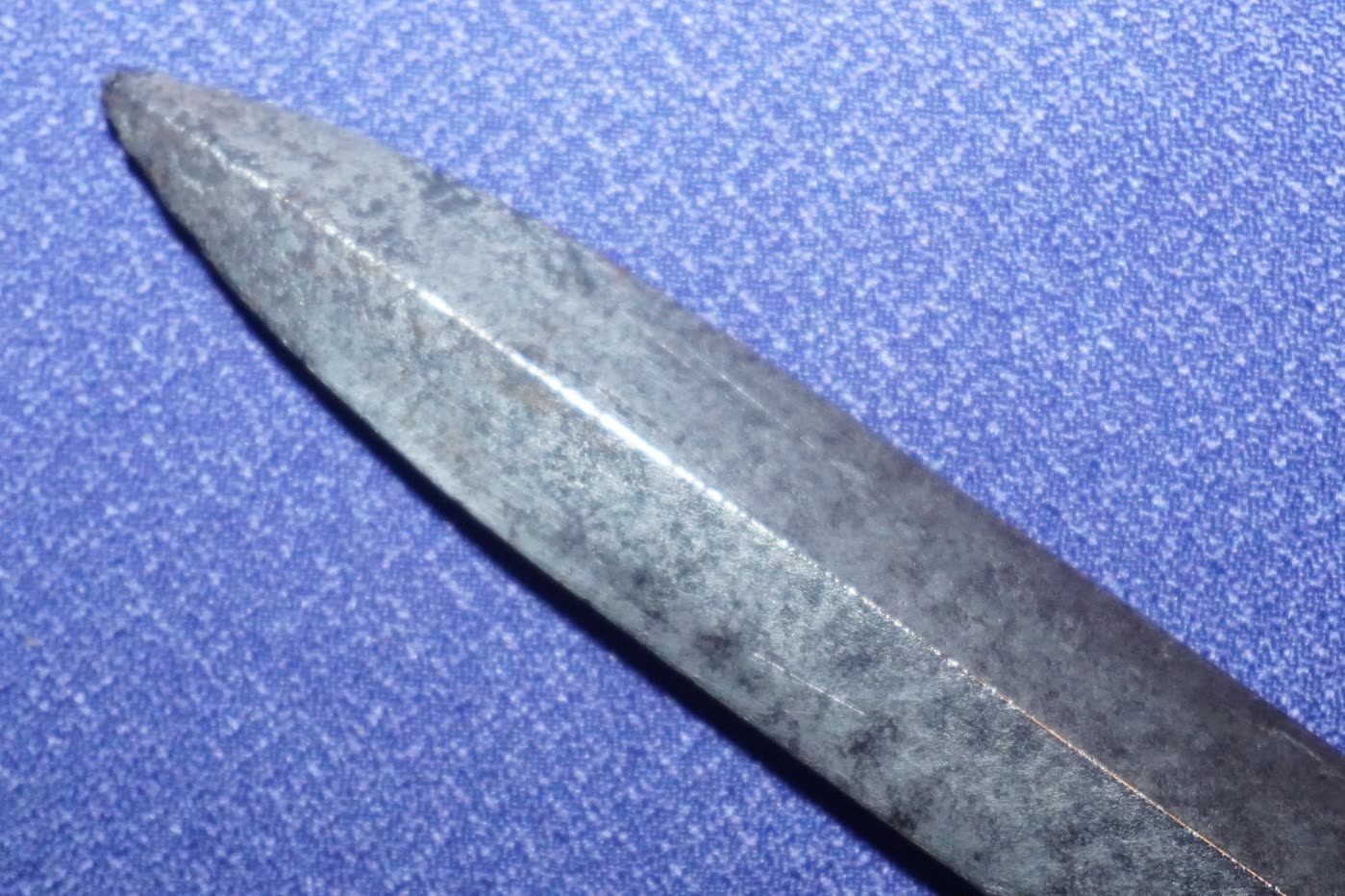
Plate II.12 · 穂・茎
Point · first face
The point at close range: intact and still acute, with the ridge carried right to the tip and the surface cleaner here than along the body.
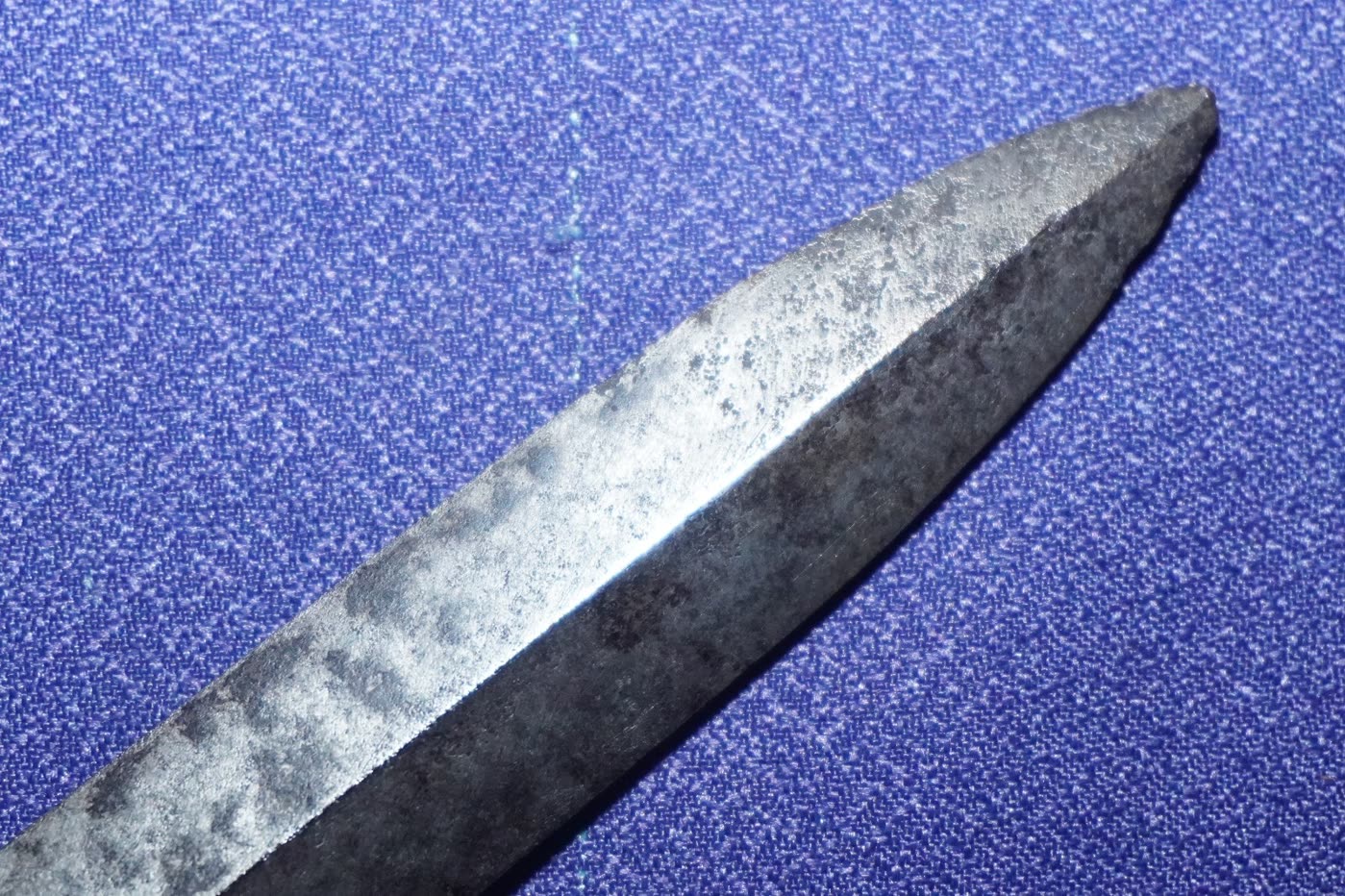
Plate II.13 · 穂・茎
Point · second face
The point from the other face, showing the same unbroken outline and a bright line where light catches the ridge.
Photographs courtesy of GN-1-Japan, used with permission.
Revision history
- Catalogue record established from the ended listing and its 21 gallery photographs; chiselled characters on the tang are recorded although the source describes the blade as unsigned.